
Physiologist by training, passionate observer, and extraordinary educator, Cyrille Gindre founded Volodalen with a simple idea: everyone moves in their own way. This manner of moving, far from being random, follows natural laws that can be observed, understood, and integrated into training. Compared to the ActionTypes method, often perceived as its ancestor or cousin, Volodalen offers a vision more deeply rooted in physiology and real-world analysis. Here is the story of a journey where intuition, science, and freedom converge.
 Cyrille Gindre - Volodalen
"I couldn’t stand school. I learned better on my own than by memorizing what I was told." Today, as Scientific Director of Volodalen, Cyrille Gindre has never been one to follow imposed formats. This instinct to diverge has accompanied him since adolescence—and has shaped his entire methodology. After excelling in STAPS studies in Strasbourg without closely following lectures, he earned a DEA (Advanced Studies Diploma) in exercise physiology. In parallel, he completed various national certifications in sports: Level 1 and 2 State Diplomas in athletics, as well as certifications as a timer, judge, and coach within the French athletics and triathlon federations. He became passionate about physiology. But quickly, he became disillusioned. "When I saw that anaerobic threshold had 30 different definitions in the literature, I realized we were lost in vagueness."
He then sought biological constants and natural laws—elements resistant to time and context. On the field, at the Sports Medicine Institute of Troyes, he began to find answers. As early as the 2000s, he also started publishing in specialized magazines such as Jogging International, Sport & Vie, and Zatopek, where he popularized physiological training principles well before adopting the language of preferences. He created the volodalen.com website to share his thoughts, tools, and analyses with the public and training professionals. This site would later become a major showcase for the method.
From Muscle to motor behavior :
By testing thousands of athletes through Bosco tests, VO2max analysis, plyometric jumps... , he identified very different motor profiles. Some rebounded lightly, others sank and pushed. Some were faster on short ground contacts, others more powerful on long contacts. Emerging categories appeared: contractile vs. elastic, thigh vs. foot dominance. These became the first building blocks of the "motor spectrum," a way of reading movement as a continuum rather than a typology.
Terrestrial and Aerial: Observation before concept :
"I saw runners glued to the ground, others bouncing like balls. But neither was 'bad'.'' Refusing value judgments, Cyrille focused on observing and linking movement strategies. He compared ways of producing movement. Gradually, the terms became clear: terrestrial, aerial, rebound, push, close, wide... This lexicon, which has become a reference, emerged from field experience, tested and documented.
Meeting ActionTypes: A useful trigger, not a conversion :
In 2009/10, Cyrille met Bertrand Théraulaz, co-founder of ActionTypes. "It was then that I realized there could be a link between cognitive and motor patterns. Honestly, I hadn’t really believed it before."
Cyrille attended a foundational ActionTypes course and engaged with the material. Reflecting on that experience, he explains: "Their vision is very typological, with a strong neuro-cognitive dimension. I needed measurements, numbers, and proof." The meeting acted as a catalyst: it opened a door without redirecting his entire approach.
While Volodalen remains firmly rooted in physiology and measurable data, it also actively embraces the cognitive and emotional dimensions. Recent studies, such as 'Mind to Move' (2024), provide scientific evidence that personality traits (sensing vs. intuition) shape natural motor patterns, exemplifying the embodied cognition approach. This integration broadens the spectrum of preferences without making cognition the primary starting point.
The Move Dial: Volodalen’s grammar :
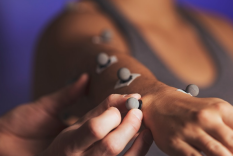
On a train between Aigle and Pilosane, Cyrille formalized one of his most important contributions: the Move Dial. This model defines, in a three-dimensional framework, individual motor balance points. It combines support strategies, breathing, laterality, and postural balance into a simple, operational, and verifiable reading of movement.
Grounded in Ongoing Scientific Research:
Since 2015, Volodalen has published more than 60 scientific articles, supervised multiple doctoral theses, and developed practical tools such as the V-score, Mind to Move, and energy preference tests. "I don’t invent anything in an ivory tower. I observe, model, test, and if science contradicts me, I revisit. That’s how progress happens."
Distinct Frameworks:
ActionTypes and Volodalen share a common intuition: each person moves uniquely. But their paths differ. While ActionTypes is built around cognition and psychological typologies, Volodalen is anchored in the body, physiology, and measurable data. One framework organizes movement through typological categories, while the other approaches it through measurable continua and physiological spectra. These are two worlds that can communicate, but according to Cyrille Gindre, must not be confused.
It is important to note that the two approaches developed in parallel, each following its own logic and pace. The meeting between Cyrille and the founders of ActionTypes led to a brief but meaningful collaboration. It identified common ground (the link between movement and cognition) but quickly led to the emergence of two distinct directions.
Volodalen structured itself around physiology, the field, and scientific validation, while ActionTypes followed a path more rooted in cognitive typologies and behavioral approaches.
Volodalen is the result of over twenty years of research, rigorous observation, and continuous dialogue between theory and practice. It is a patient construction anchored in reality, which continues to evolve with science and athletes.
"The link between motor and cognitive domains was one of the last bridges I accepted to build. But my roots remain clear: everything starts and stays grounded in the interplay between fieldwork and science, between muscles, ground, and objective data. That’s where it all begins, and that’s where I choose to stay." — Cyrille Gindre
Volodalen is:
- First and foremost a research laboratory with PhDs
- Over 10,000 training sessions delivered since 2016
- Over 50 medals and titles (Olympic Games, national, European, and world championships)
- More than 25 sports disciplines covered
- Over 45 collaborators and trainers
- More than 3,000 athletes followed
Volodalen integrates research, education, and clinical practice.
At Volodalen, respecting motor preferences means, above all, respecting each person's individual choice. There is no right or wrong way to approach these preferences: there is simply the one that resonates with the individual, the one that allows them to fully express themselves in their movement and performance.